
LAW
With undergraduate (UG), graduate (PG), and doctorate (LLD) levels available for study, research, and practice in India, law is a highly sought-after academic course. The duration of a law course is determined by the courses you choose, one of the most common is the three-year Bachelor of Laws (LLB) program, for instance, which requires a bachelor’s degree in any discipline. An alternative is to enroll in a five-year integrated law degree program.
You can obtain both degrees at the same time by combining a bachelor’s degree in the arts, business administration, science, or commerce with a legal degree through programs like B.B.A.LL.B, B.A.LL.B, B.Sc.LL.B, or B.Com.LL.B. Indian law schools also provide a two-year master’s degree in law (LLM course), followed by a doctorate degree (LLD), for individuals who choose to pursue a career in law as a legal researcher, Legal Practitioners, Legal Advisors, Consultants, Researchers, Jurists, Caseworkers, and more.

With undergraduate (UG), graduate (PG), and doctorate (LLD) levels available for study, research, and practice in India, law is a highly sought-after academic course. The duration of a law course is determined by the courses you choose, one of the most common is the three-year Bachelor of Laws (LLB) program, for instance, which requires a bachelor’s degree in any discipline. An alternative is to enroll in a five-year integrated law degree program.
You can obtain both degrees at the same time by combining a bachelor’s degree in the arts, business administration, science, or commerce with a legal degree through programs like B.B.A.LL.B, B.A.LL.B, B.Sc.LL.B, or B.Com.LL.B. Indian law schools also provide a two-year master’s degree in law (LLM course), followed by a doctorate degree (LLD), for individuals who choose to pursue a career in law as a legal researcher, Legal Practitioners, Legal Advisors, Consultants, Researchers, Jurists, Caseworkers, and more.
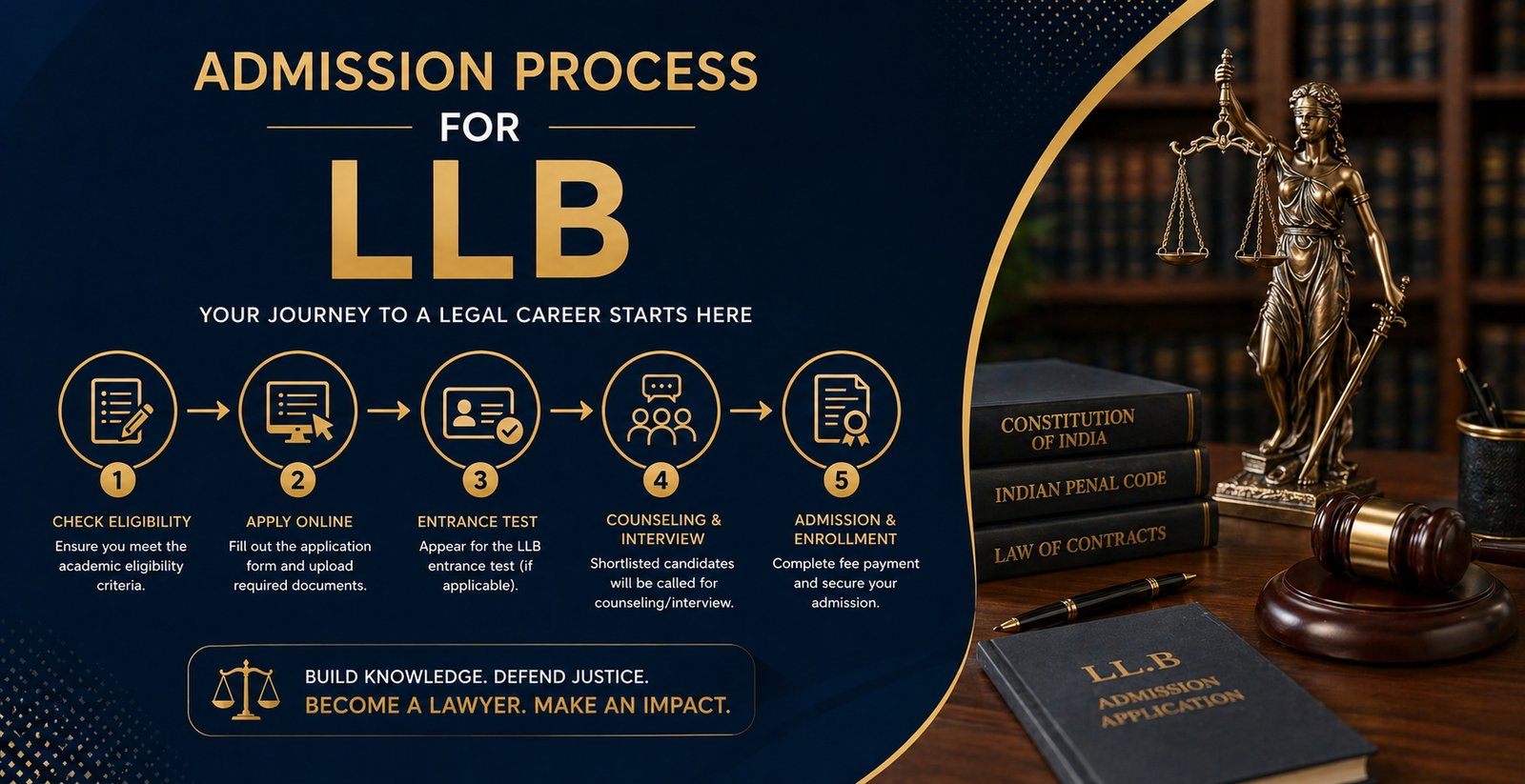
Law Course: A Detailed Overview
Law is one of the most extensively researched academic disciplines. It studies the rules, norms, and practices that govern a society and are considered mandatory for its members. Numerous specializations, such as criminal law, civil law, constitutional law, corporate law, and more, are taught at Indian law schools.
|
Particulars |
Law Details |
|---|---|
|
Law Courses |
5-year course, 3-year law degree, Masters, and Doctorate |
|
Law Eligibility |
|
|
Law Course Duration |
|
|
Law Top Colleges |
NLSIU, NLU Delhi, NLIU, Jamia Millia Islamia, NALSAR |
|
Law Job Positions |
Legal Manager, Advocate, Solicitor, Legal Advisor, Law Officer |
|
Law Entrance Exam |
DU LLB Entrance Exam, Telangana State Law Common Entrance Test, BHU Undergraduate Entrance Test, CLAT UG |
|
Top Law Recruiters |
Bar Council of India, Multinational Companies, Law Firms, Government Departments, Public Sector and Private Sector Banks, Legal Process Outsourcing |
Types of LLB Courses in India
There are mainly two types of LLB courses offered in India. These are detailed below.
5-Year Integrated LLB
The 5-year integrated LLB course is an undergraduate program offered by several law colleges in India. Candidates can pursue this course right after completing their Class 12th. The total duration of the course is 5 years integrated LLB programs.
- BA LLB: Includes subjects like Sociology, History, and Political Science
- BBA LLB: Includes subjects related to business management and corporate law.
- BCom LLB: Includes commerce or accounting with law.
- BSc LLB: Includes science subjects with legal studies.
3-Year LLB
The 3-year LLB program is offered to graduate students in India. The subjects included focus solely on the legal system of India. BCI-approved topics are taught in the 3-year LLB program, such as Constitutional Law, Criminal Law, and Civil Law.
Get Free Admission Guidance Today

Law Courses: Eligibility Criteria
Different selection procedures, eligibility requirements, and legal credentials for admission at the postgraduate and postgraduate levels vary throughout Indian law colleges. Nonetheless, the following are the fundamental requirements that applicants must meet in order to be admitted to legal programs provided at the undergraduate, graduate, or doctorate levels and get a law degree:
Law Courses After 12th / Law Study After 12th
|
Course Types |
Eligibility |
Entrance Exam (if any) |
|---|---|---|
|
LLB after Graduation |
Must have a bachelor's degree in any discipline with a minimum of 45% for unreserved category applicants and 40% for reserved category applicants. |
CLAT, AILET, and state-specific exams |
|
BA LLB (Hons) |
Must have passed the 10+2 or equivalent from a recognized board. |
CLAT, AILET, state-specific exams |
|
BA LLB |
Must have passed the 10+2 or equivalent from a recognized board. |
CLAT, AILET, state-specific exams, and some colleges conduct their own entrance exams |
|
BBA LLB |
Must have passed the 10+2 or equivalent from a recognized board. |
CLAT, AILET, state-specific exams, and some colleges conduct their own entrance exams |
|
Law after Graduation |
Bachelor's degree in any discipline from a recognized university. |
CLAT PG and some colleges conduct their own entrance exams |
|
LLM |
LLB degree from a recognized university. |
CLAT PG and some colleges conduct their own entrance exams |
|
PhD (Law) or LLD |
LLM degree from a recognized university. |
Varies by university |

List of the Best Law Colleges
Government Law Colleges |
Private Law Colleges |
||
|---|---|---|---|
|
National Law Institute University, Bhopal |
Amity University, Gurugram |
||
|
Guru Gobind Singh Indraprastha University |
Amity University, Noida |
||
|
Indian Law Institute |
Lloyd Law College |
||
|
National Law University Odisha |
ICFAI Law School |
||
|
Punjab University |
GITAM School of Law |
||
|
National Law University Jodhpur |
KIIT Law School |
||
|
Ram Manohar Lohia National Law University, Lucknow |
ILS Law College |
||
|
National Law University and Judicial Academy, Assam |
SASTRA Deemed to be University |
||
|
Rajiv Gandhi National University of Law |
Lovely Professional University |
||
|
National University of Study and Research in Law |
UPES |
||
|
Symbiosis |
|||
|
Rizvi Law College |
|||
|
Bharti Vidhyapeeth |